
Today’s logistical warehouse — operating at high capacity with narrow aisles — requires a floor with near-perfect flatness. SUPERFLAT-NY specializes in Very Narrow Aisle grinding to perfect your floor surface texture, whatever the intended use.
Million square feet remediated
Years of industry experience
Tolerances routinely achieved
Where warehouse space is at a premium, a Very Narrow Aisle racking system with Adjustable Pallet Racking stores a far higher concentration of pallets in the same footprint by reducing aisle width. But every foot you take out of the aisle takes tolerance out of the floor.
A trilateral trolley cannot travel correctly if it is constantly shaken by irregularity in the slab. At VNA heights and speeds, a traditional industrial floor stops being a surface and starts being a liability — mast sway, rack impacts, handling errors, slow-downs, and in some cases a complete halt to operations.
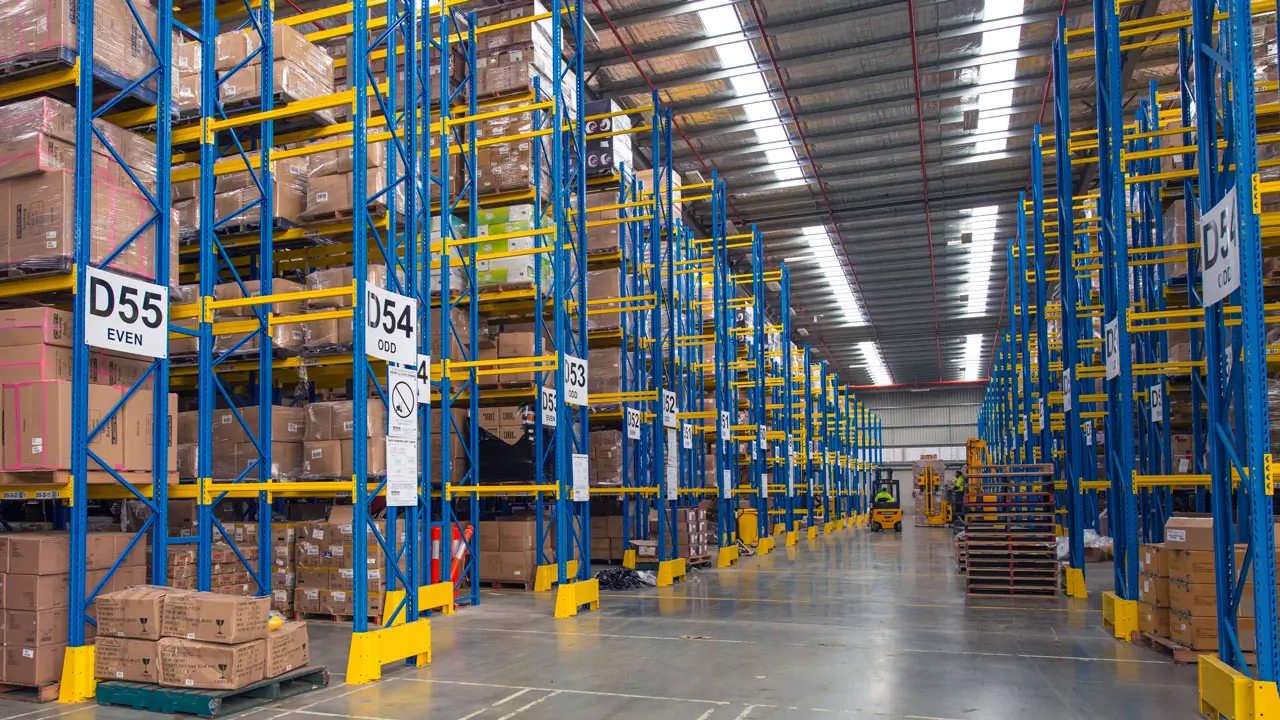
VNA racking depends entirely on the tolerance of the slab beneath it.
| AISLE TYPE | TYPICAL WIDTH | WHAT RUNS IN IT |
|---|---|---|
| Wide aisle | 12–13 ft | Counterbalance forklifts |
| Narrow aisle | 8–10 ft | Reach trucks |
| Very narrow aisle (VNA) | 6 ft or less | Turret trucks, wire/rail-guided trolleys, AS/RS |
During construction of large facilities, floors are commonly placed and finished in pours of 50,000 to 80,000 square feet or more, using laser screeds and large riding trowels with pans. That process produces a good commercial floor. It does not produce a VNA floor.
Add time to that slab and the gap widens. Joints and cracks curl. Slabs settle. A building that sits empty for six months before it is occupied will almost certainly need remediation before a turret truck ever enters an aisle.
Remediation brings the surface back to a specified tolerance by milling and grinding either the material handling equipment wheel paths only, or the full width of the aisles between racks to increase throughput. Which approach we recommend depends entirely on your specified tolerance and how you intend to run the building.
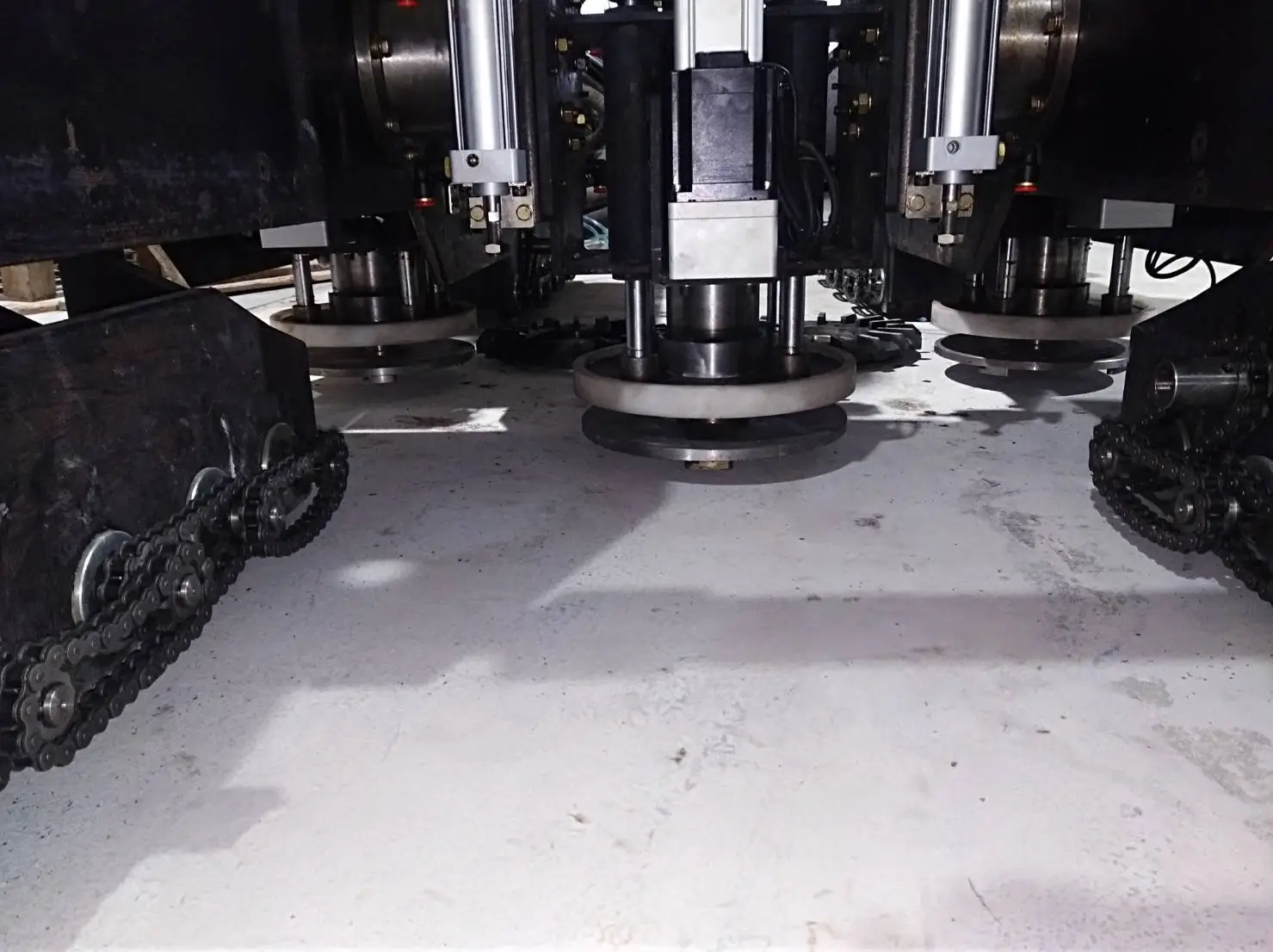
Laser- and GPS-guided grinding corrects the slab without shutting the building down.
When the conversation turns to very narrow aisles, the measurement system changes. Defined-traffic floors are specified using the ACI F-min numbering system, not Ff/Fl.
These are altogether different measuring systems. There is no direct correlation between the two and no corresponding index for comparison. A single F-number — F-min — defines the worst acceptable flatness and levelness condition permitted anywhere in a VNA aisle, and the required value is assigned based on expected lift truck type and rack height. The taller the rack and the faster the truck, the higher the F-min.
Worked example. A building is specified and signed off at Ff 50/Fl 35, then sits vacant for six months. Depending on how the incoming tenant lays the facility out, and on how much curling and settling occurred while the building was empty, that floor will likely require remediation to reach F-min 50 to F-min 100 — or higher, if the forklift manufacturer’s recommendations or the architect’s and engineer’s tolerances demand it. That is where Superflat comes in.
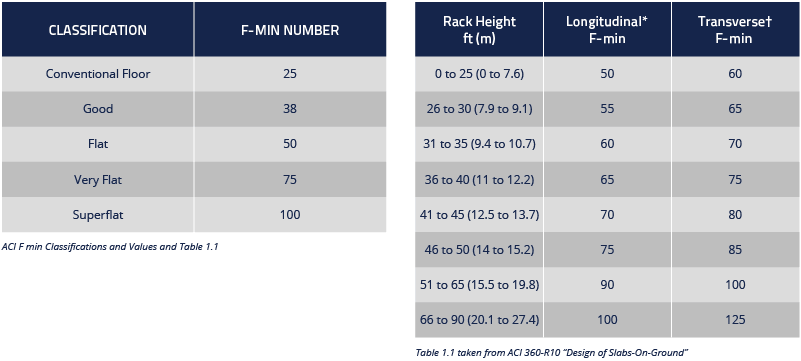
ACI 360R-10, Table 1.1 — required F-min by classification and racking height.
Four stages, one crew, one accountability chain — from the first survey to the closeout documentation.
We survey the existing slab and profile every aisle against your specified tolerance — working in Ff/Fl, F-min, the DEN Standard, or a competitor’s proprietary system, whichever your project is written to.
We build a 3D model of the floor and design the cut. The objective is to remove the least material possible while still achieving the required F-min, which protects both the slab and your budget.
Our laser- and GPS-guided Superflat grinders execute the cut. The process is quick and quiet enough to run alongside an operating facility.
We re-profile the corrected aisles and issue documentation showing the finished floor meets specification.
Significantly improved space utilization — more pallets in less space
Reduced cost per square foot and per pallet stored
No need for offsite storage
No costly building expansion
Improved pick rates
Direct access to every pallet location
Less pallet rack damage
Higher forklift productivity
olving complex very narrow aisle problems is our wheelhouse. Our team uses the latest laser- and GPS-guided grinding equipment with state-of-the-art cutting tool designs to deliver the most precise work available — reducing labor, eliminating human error, and keeping the job on schedule and inside budget.
We will level your floors with complete accuracy so operations continue uninterrupted. And unlike most of our competition, we are not locked to a single measuring system.
“During the time that they were on site, there was no interruption to our work in the facility. In fact, we barely even knew that they were here.”
Whole Foods · Boston, MA
No. We work from a 3D model specifically so we can remove the least material possible while still achieving the F-min required for the job. That saves time and labor, and it protects your budget from unnecessary cost.
Yes. Our grinding process is quick and quiet, and we routinely phase work around live operations, including nights and weekends. Clients regularly tell us they barely knew our crews were on site.
Whichever one your project is specified to. Superflat® works with Ff/Fl, F-min, the DEN Standard, and competitors’ proprietary measuring systems.
We routinely deliver F-min 50 to F-min 100 and above, set by your lift truck manufacturer’s recommendations and your engineer’s tolerances.
Superflat works with hundreds of customers on nearly any size job. Our team has completed millions of square feet of precision work for companies including Amazon, AutoStore, KPI, Target, Ryan Companies, Whiting-Turner, Baker, and Lithko — to name just a few.
Send us your aisle layout, rack height, and specified tolerance. We’ll tell you what your floor needs.
Correcting random-traffic floors to the strictest superflat specifications.
Full-coverage measurement for complex surface flatness analysis.
Cleaning, repair, joint filling, and texture work packaged with your project.